You filed the Articles. You got the EIN. Now Illinois says there's a third registration — and you're not sure where to start.
Your charity is incorporated with the Secretary of State. The IRS has your Form 1023 (or it's pending). Before most charities ask anyone in Illinois for a donation — online, in person, or through a fundraising event — the Attorney General's Charitable Trust Bureau requires registration under the Solicitation for Charity Act. Statutory exemptions apply to some organizations.
The official forms are free. The instructions are dense. And the questions start piling up: Does our charity qualify for an exemption, or do we need to file everything? What attachments go with Form CO-1? What happens if our IRS determination letter hasn't arrived yet? Who has to sign the annual report, and when is it due?
Commercial filing services charge $99 to $300 or more — plus recurring registered agent fees. Form CO-1 asks for an Illinois registered-agent name, address and telephone number, but it does not ask for proof of a paid commercial-agent service. A nonprofit attorney runs $250 to $600 an hour. For a small charity run by volunteers, those numbers don't work.
The Illinois Charity Filing Navigator — every form, attachment, deadline and exemption rule in one guide
This is a plain-language guide built for volunteer officers who want to handle the Attorney General registration themselves, correctly, without paying a vendor to do what a well-prepared board can do on its own. It covers the full lifecycle: initial registration (Form CO-1), the financial-information schedule for new organisations (CO-2), the religious exemption (CO-3), annual reporting (AG990-IL), the updated audit thresholds under Public Act 103-0121, and the fees and penalties you need to track.
Where free government forms tell you what to file, this guide shows you how — in what order, with what attached, and with the common mistakes flagged before you make them.
What's inside
- Exemption Decision Framework — a printable test that walks you through the small-charity threshold ($15,000 in gross contributions in any 12-month period ending December 31), the religious-organisation exemption, and other statutory categories. Know whether you need ongoing reports, an initial CO-1 followed by a report exemption, or no Solicitation for Charity Act registration under a Section 3(b) category.
- Form CO-1 Filing Walkthrough — every field explained, with an entity-specific checklist: Articles and Bylaws for corporations, a Constitution and Bylaws for unincorporated associations, applicable trust documents, an officer roster, the IRS determination letter or, if an application is pending, a copy of Form 1023 or 1024 (or a written explanation if unavailable), and applicable professional-fundraiser contracts. No guessing what goes in the envelope.
- Form CO-2 for brand-new charities — how to handle the financial-information schedule when your organisation has less than a year of activity and little or no historical data to report.
- Form CO-3 Religious Exemption — religious organisations seeking the annual-report exemption must file CO-3 with CO-1 for the Bureau's determination. The exemption is not automatic.
- AG990-IL Annual Report Guide — your deadline (six months after fiscal year-end), the signature rules (president or other authorized officer and chief fiscal officer, or two trustees; a sole trustee may sign alone), the simplified filing option for small charities, extension requests, and the late-fee consequences of missing it.
- PA 103-0121 Audit Threshold Breakdown — the updated financial-reporting tiers, the exception that drops the audit threshold to $25,000 when paid fundraising help is involved, and the January 2029 sunset on Section 4 changes. Presented as a decision table, not a statute.
- Fee and Penalty Quick-Reference — registration and reporting fees in one table: $15 initial registration, $200 re-registration after cancellation, and a $15 annual-report fee when due (for Solicitation Act charities, contributions over $15,000 or assets over $25,000; for Charitable Trust Act-only filers, revenue or assets over $25,000). It also covers the $200 late-registration fee for soliciting before registration, the $100 fee per late report, and the court-imposable $500–$1,000 civil penalty under either Act for failure to register or maintain a required registration. Plus an internal ledger template so your treasurer can track what was paid and when.
- Online Portal Guide — the Charitable Trust Bureau's filing system accepts initial registrations, annual reports, and extension requests. The guide covers what to expect from the portal alongside the paper-form option.
- Annual Compliance Calendar — a tracking sheet that calculates your AG990-IL due date from your fiscal year-end, flags extension windows, and keeps you ahead of the Charitable Trust Bureau's notices.
- 10 Standalone Printable Worksheets — a filing package assembly checklist, exemption self-test, registration sequence card, contribution threshold tracker, audit threshold decision table, fee and receipt log, agency communication log, regulatory contact directory card, and a deficiency response tracker. Each is a separate PDF your board can print and fill in without opening the main guide.
Who it's for
- Volunteer founders registering a new charity with the Illinois Attorney General for the first time
- Treasurers and finance chairs who need to understand the difference between the Secretary of State (corporate existence), the IRS (federal tax exemption) and the Attorney General (charitable solicitation authority)
- Religious-organisation leaders working out whether they need to file Form CO-3 for the annual-report exemption
- Board officers who have received a past-due notice and need to clear overdue annual reports and late fees
- Small charities at or below $15,000 in gross contributions in a 12-month period ending December 31 who want to confirm that their report exemption is on file before soliciting
Why not just use the free forms?
You absolutely can. The Attorney General publishes every form — CO-1, CO-2, CO-3, AG990-IL and IFC — free of charge, along with instruction sheets and the full statutory text. This guide links to those forms and encourages you to use them.
What the official materials don't provide is a step-by-step workflow that ties the forms together: which one to file first, what attachments to gather before you start, what to do when your IRS determination letter hasn't arrived yet, and how to calculate your annual-report deadline from your fiscal year-end. The exemption rules alone trip up most first-time filers — many assume a small charity is automatically exempt, when in fact you must file the initial CO-1 and receive the Attorney General's determination before you are excused from ongoing reports.
The guide fills the gap between having the forms and knowing what to do with them.
What this guide is not
This is process navigation — it is not legal, accounting or tax advice. It is not published, endorsed or affiliated with the Illinois Attorney General, the Secretary of State, the IRS, or any other government body. The guide does not file anything for you, does not guarantee approval, and does not replace professional counsel for complex situations. Fees, thresholds and portal addresses change; every figure is dated so you can verify it against the current official source.
Satisfaction guarantee
If the guide doesn't help, email [email protected] for a full refund, no time limit.
Get started
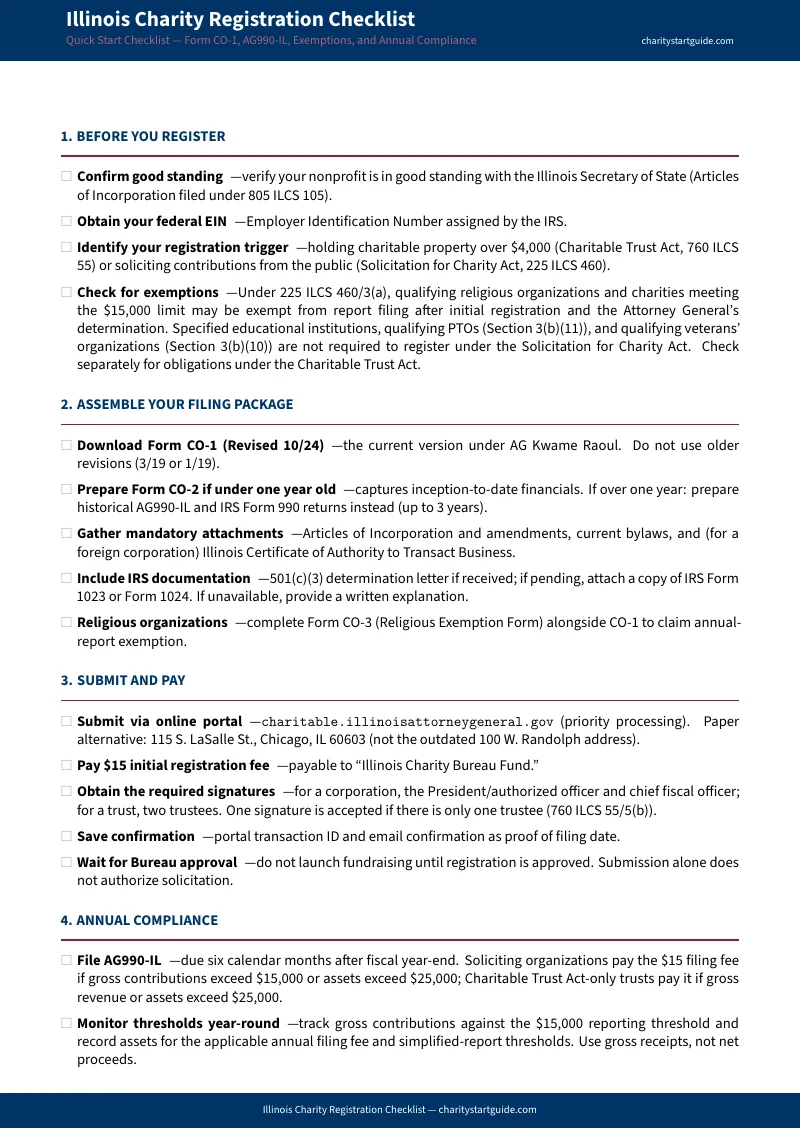
Download the free Illinois Charity Registration Checklist to see the exemption summary, corporate attachment items, fee thresholds, and online and paper filing details at a glance — or get the full guide for the step-by-step workflows, exemption framework, and annual compliance tools your board needs to stay current with the Attorney General.
Frequently Asked Questions
What if the rules change after I buy?
We update the guide when the rules change. Email us any time, even years later, and we'll send you the current edition free.