You incorporated. You got your EIN. Now you need the determination letter — and the IRS worksheet has 34 questions standing in the way.
Your board agreed to apply for 501(c)(3) status so donors can deduct their gifts and grant-makers will take your applications seriously. You downloaded the Form 1023-EZ instructions. And then you hit the eligibility worksheet.
Thirty-four questions about gross receipts projections, asset thresholds, organizational types you have never heard of, and activities that could disqualify you from the streamlined form entirely. The instructions tell you to cross-reference IRC Section 501(c)(3), Treasury Regulations, and three separate IRS publications — but they do not tell a volunteer treasurer which answers mean the full Form 1023 is required, what to expect if the IRS asks for more information, or how to calculate the financial ceilings with numbers from an organization that barely exists yet.
Meanwhile, the 27-month clock is ticking. Generally, if the IRS approves your application and you file within 27 months after the end of your formation month, your exemption dates back to your formation date. If the IRS approves a later Form 1023-EZ, its effective date is the submission date; to request an earlier date, file the full Form 1023.
The Pre-Flight Filing System: verify eligibility, prepare your records, file on Pay.gov, and handle everything after
This guide replaces the scattered, cross-referenced IRS publications with a single walk-through that takes a founding board from "Are we eligible?" to "The determination letter is filed and verified." It is built around the form itself — the eligibility worksheet, the six parts of Form 1023-EZ, and the Pay.gov filing portal — so you work through each step in the order you actually encounter it.
What's inside
- The 34-question eligibility diagnostic — each worksheet question translated into plain language, with the gross receipts ($50,000) and asset ($250,000) calculations worked through for a brand-new organization that has little or no financial history yet. You will know, before you pay the $275 IRS user fee, whether Form 1023-EZ is the right form.
- The articles-of-incorporation clause check — examples of acceptable purpose and dissolution language, plus a check against the IRS organizational test. Your organizing document must limit your purposes to Section 501(c)(3). In some states, applicable law can satisfy the dissolution requirement if the document has no conflicting provision. The guide shows you how to check your filing and when an amendment may be needed.
- Part III activity and attestation walk-through — what the 250-character activity description asks for, how the key compliance attestations work, and what to expect if the IRS requests more information.
- Public charity classification, decided — 509(a)(1) or 509(a)(2)? The guide works through both options with examples: a community food pantry funded by local donors versus a youth sports club funded by registration fees. Your board picks the right classification before the form asks for it.
- The 27-month clock, calculated — a worked date example so you can count your own deadline. The guide explains when the window opens, when it closes, what "end of the month in which you were formed" means in practice, and what happens to donations made before your effective date.
- Pay.gov filing, step by step — account creation, the user fee payment, the submission confirmation you need to save, and the receipt that proves you filed.
- The post-filing playbook — how to check your application status, what to do when the IRS sends a supplemental information request, how to handle donor questions while your application is pending, and what your determination letter means when it arrives.
- Annual filing obligations — the 990-N, 990-EZ, and 990 thresholds, the three-year revocation rule that catches small charities who forget to file, and what changes as your revenue grows.
- Six standalone printable tools — an eligibility pre-flight worksheet, an organizing documents verification checklist, a 27-month deadline calculator, a Pay.gov filing preparation checklist, a determination letter verification checklist, and an agency communication log. Each is a fill-in-by-hand document your board can use at the step where you need it.
Who this is for
Volunteer founders, treasurers, and board members of a small US charity — a community group, food pantry, youth sports club, parents' organization, or faith group — applying for 501(c)(3) tax-exempt status for the first time. You have incorporated (or you are about to), you have your EIN, and you want to handle the federal application yourselves instead of paying a formation service hundreds of dollars to type the same information into the same Pay.gov fields.
Why not just use the free IRS instructions?
You absolutely can. The Form 1023-EZ instructions, Publication 557, Publication 4220, and the Pay.gov portal are all free. The IRS even maintains a Stay Exempt training site. Those resources describe each rule accurately — they were written by the people who enforce them.
What they were not designed to do is put a first-time filer's steps in order. The instructions assume you already know which IRC sections apply to you. Publication 557 covers every type of tax-exempt organization, not just small 501(c)(3) charities. And the eligibility worksheet asks questions about donor-advised funds and supporting organizations without explaining what those are or why they matter to a food pantry that just wants to accept tax-deductible donations.
The guide reorganizes the government's own rules into the sequence a volunteer board actually follows: check eligibility, prepare your articles, complete the form, pay the fee, file, wait, and handle the determination letter. For a founding team working evenings and weekends, the difference between cross-referencing three publications and following one walk-through is hours of volunteer time that could have gone to the work your charity was created to do.
What this is not
Charity Start Guide is an independent publisher. This guide is not affiliated with the IRS, Pay.gov, or any government agency. It does not file anything for you, provide legal or tax advice, or guarantee that the IRS will approve your application. The IRS decides whether to approve an application for recognition of 501(c)(3) status, and no guide, attorney, or formation service can guarantee that decision.
If your organization has complex activities — foreign operations, a school, a hospital, significant real estate, or revenue well above the $50,000 threshold — a nonprofit attorney is the right starting point. The guide lists SCORE for free nonprofit mentoring, state-by-state compliance resources, IRS StayExempt, and ways to find regional pro bono legal providers.
Satisfaction guarantee
Full refund, no time limit. If the guide does not help your board file with more confidence, email [email protected] and we will refund your purchase — no questions, no deadline.
Start filing with clarity
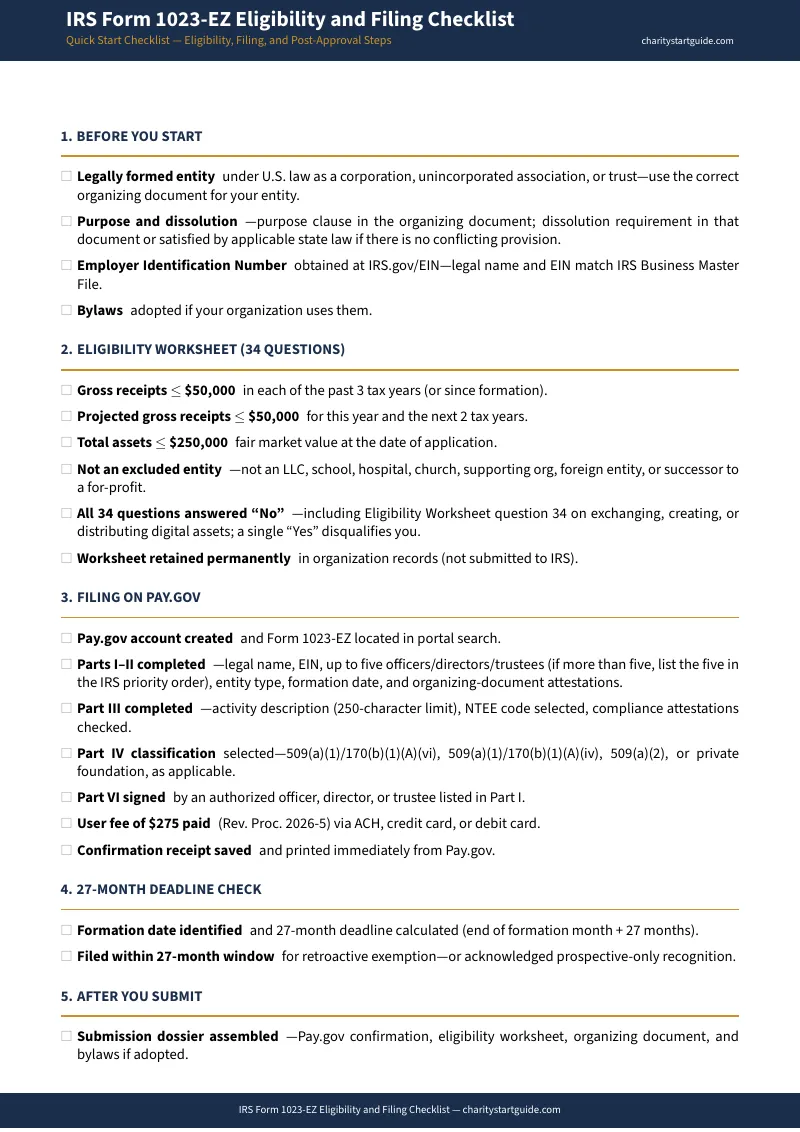
The free checklist gives you the high-level eligibility tests and filing steps. The full guide gives you the diagnostic detail — the clause language, the financial calculations, the attestation map, the post-filing playbook — so your board can file once, file correctly, and get back to the work you incorporated to do.
Frequently Asked Questions
What if the rules change after I buy?
We update the guide when the rules change. Email us any time, even years later, and we'll send you the current edition free.