Your charity is incorporated and tax-exempt — but New York says you still can't fundraise
You filed your Certificate of Incorporation with the Department of State. You received your IRS 501(c)(3) determination letter. You set up a donation page, applied for a grant, or opened a bank account — and someone asked for a six-digit New York State Registration Number you've never heard of. You searched the Attorney General's website and found two different statutes (Article 7-A and EPTL § 8-1.4), a mandatory online portal, and no clear answer about which category applies to you, what to attach, or how most organizations coordinate two officers' digital signatures (trusts require at least one trustee signature).
Meanwhile, Article 7-A registration is generally due before soliciting contributions in New York; a qualifying small charity has 30 days to register after its gross contributions exceed $25,000 during the fiscal year. If you're already soliciting without a required registration, the Charities Bureau can flag your organization as delinquent, and payment processors, grantmakers and financial institutions may withhold services until your status is cleared.
The New York Charities Bureau Filing Navigator
This is not a generic "how to start a nonprofit" overview. It is a step-by-step operations manual built specifically for the New York Attorney General's Charities Bureau — the filing that most formation guides skip, most incorporation services charge hundreds extra for, and most volunteer treasurers discover only when a grant application or bank audit forces the question.
The guide takes you from "do we even need to register?" through your first Form CHAR410 filing, the two-officer DocuSign signature process (trusts require at least one trustee signature), and every annual Form CHAR500 renewal after it, with the forms, attachments, fees and audit thresholds in the order you actually need them.
What's Inside
- Two-Statute Exemption Self-Test — a printable flowchart that separates Article 7-A solicitation rules from EPTL § 8-1.4 asset-holding rules, because a non-exempt charity receiving under $25,000 in gross contributions that holds a $100,000 endowment still has to register under EPTL
- Form CHAR410 initial registration walkthrough — the required uploads (Certificate of Incorporation, Bylaws, applicable IRS application or determination letter), the portal's PDF-only upload requirement, the $25 Article 7-A fee (or $0 for EPTL-only), and how to file while your IRS determination letter is still pending
- DocuSign Two-Officer Signature Map — the two-signatory workflow between your authorized officer and the person with fiscal responsibility (trusts require at least one trustee signature), step by step, so neither person's session times out or causes a portal rejection
- Form CHAR500 annual filing guide — the filing deadline for each registration type (Article 7-A and Dual: 15th day of the 5th month; EPTL-only: last day of the 6th month), the automatic 180-day extension, and the schedules for each category
- Executive Law § 172-b Audit Threshold Calculator — a plain-language worksheet so your treasurer can determine whether your charity needs unaudited statements, a CPA review (gross revenue and support of at least $250,000), or a full independent audit (over $1,000,000)
- Fee schedule reference — the statutory fee tables for Article 7-A (based on total support, revenue and professional-fundraiser use), EPTL (based on net worth), and Dual registrants (both), plus the separate $25 Department of State filing fee for organizations required to report under §§ 172-e or 172-f
- Delinquency catch-up workflow — if your status already shows delinquent, the guide lays out how to file missing annual reports, respond to Bureau notices and restore active standing
- Five real-world scenarios — a new charity launching an online donation page, a small all-volunteer charity under $25,000, registering while your IRS application is pending, a charity growing past the audit threshold, and an out-of-state charity soliciting in New York
- Eight printable tools — the Registration Category Decision Worksheet, CHAR410 Pre-Filing Checklist, Annual Compliance Calendar, Executive Law § 172-b Audit Threshold Calculator, Solicitation Disclosure Compliance Checklist, Agency Communication Log, DocuSign Two-Officer Signature Map, and Delinquency Catch-Up Workflow, so the next volunteer inherits a clean compliance file instead of unanswered notices and a lost portal login
Who It's For
- Volunteer founders who have just incorporated a New York nonprofit and need to register with the Charities Bureau before asking anyone for a contribution
- Incoming treasurers and secretaries who have inherited an organization and can't tell what's been filed, what's been missed, or whether last year's CHAR500 ever went in
- Board officers whose grant application or bank account requires a six-digit NY State Registration Number they don't yet have
- Small charities with under $25,000 in gross contributions trying to work out whether the Article 7-A exemption applies when the organization holds assets above that threshold under EPTL
Why Not Just Use the Free State Forms?
The official AG forms and instructions are free — and they should be your primary reference. But the state's guidance is written in statutory language and organized by regulation section, not by the order a volunteer treasurer actually needs to do things. The registration requirements span two separate statutes (Executive Law Article 7-A and EPTL § 8-1.4), and the portal instructions assume you already know which category applies to your organization.
The result: volunteer treasurers routinely confuse DOS incorporation with Charities Bureau registration, miss the registration-before-solicitation rule because they assumed the IRS determination letter was enough, fail the two-officer DocuSign workflow because one signer's session expired, or miscalculate the CHAR500 deadline because the filing date depends on registration type.
This guide takes those same free public forms and rules, strips out the statutory jargon, puts the steps in the order you need them, and adds the signature coordination, audit threshold calculator and compliance calendar that the official instructions leave to you to figure out. Corporate filing services charge $400 to $1,500 or more per year to handle this for you. The guide gives you the knowledge to handle it yourself.
Satisfaction Guarantee
Full refund, no time limit. If the guide doesn't help you navigate the Charities Bureau process, email [email protected] and we'll refund your purchase. No forms to fill out, no questions, no deadline.
Get Started
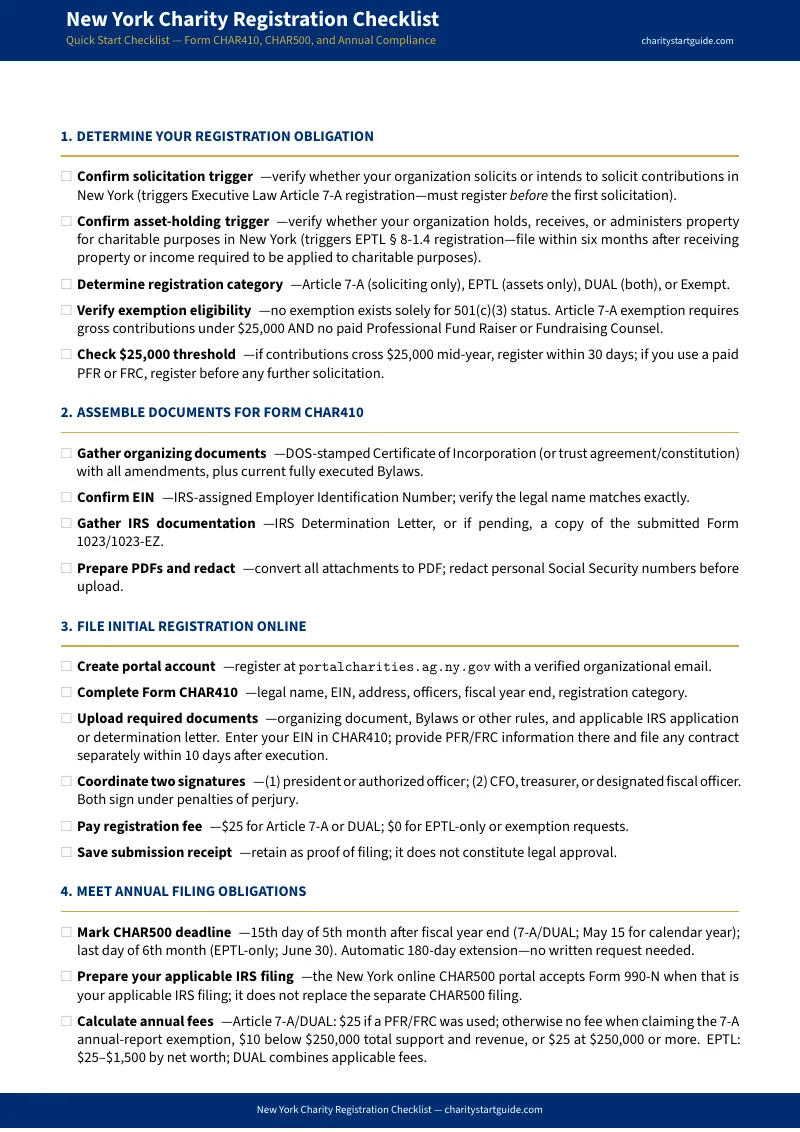
Download the free New York Charity Registration Checklist for the exemption self-test, key deadlines and links to the official portals. Ready for the full walkthrough? The complete 47-page guide plus eight printable tools — annotated form walkthroughs, the DocuSign Two-Officer Signature Map, the Executive Law § 172-b Audit Threshold Calculator, the Delinquency Catch-Up Workflow and the Agency Communication Log — is available for .
Frequently Asked Questions
What if the rules change after I buy?
We update the guide when the rules change. Email us any time, even years later, and we'll send you the current edition free.