You filed Form 202 and got your charter number. The IRS just sent it back.
The Texas Secretary of State's Form 202 is free. It is also incomplete. Printed right on the form is a warning most first-time founders skip past: "This form does not contain language needed to obtain a tax-exempt status on the state or federal level."
That missing language — a purpose limit and permanent dedication of assets to exempt purposes — is the reason most volunteer-filed articles come back for amendment. Texas law supplies a default dissolution distribution rule unless the certificate says otherwise, so an express dissolution clause is recommended. An amendment means a new filing fee, a new processing wait, and a stalled IRS application.
The state filing is only the first office. After the Secretary of State comes the IRS for the EIN and the 501(c)(3) determination. After the IRS comes the Texas Comptroller for the state franchise and sales tax exemptions. And after all of that comes a compliance calendar your board will follow for years. Most free guides cover one of these steps. This guide covers them in the order you'll actually do them, with the connections between offices that the official forms assume you already know.
The Formation-to-Exemption Blueprint
This is not a document template. It is not a filing service. It is a single walk-through of the entire Texas nonprofit incorporation sequence — the five offices, the five milestones, and the evidence trail that proves each step is done — built for a volunteer board doing this for the first time.
Form 202: the articles your nonprofit actually needs
The guide walks through every article of Form 202 line by line: the name-availability rules under 1 TAC Chapter 79, the minimum three natural-person directors for a board-managed corporation, the registered agent and registered office requirements, and the mailing address the Comptroller will use for franchise tax correspondence. Where the official form leaves a blank text area and a warning, the guide provides model purpose language required by the IRS and recommended express dissolution wording consistent with Texas law — with instructions for entering it in the SOSPortal online filing system.
Registered agent: the decision most boards make too fast
A registered agent is the person or entity that receives legal documents on behalf of your nonprofit. The guide explains who qualifies, the physical-address rule (the registered office must be a street address where process may be personally served during normal business hours), how to handle Form 401-A consent without paying an unnecessary $5 state filing fee, and the real trade-offs between using a director's home address — which becomes a permanent public record — and hiring a commercial agent.
SOSPortal filing and common rejection triggers
The guide walks through the SOSPortal account setup, the $25 filing fee (plus the $0.25 + 2.25% card convenience fee), and what to expect after submission. It covers the five most common Form 202 rejection triggers: entity name conflicts, fewer than three directors for a board-managed corporation, a defective registered agent address, a missing organizer signature, and supplemental provisions that conflict with Form 202. The guide also explains how to correct post-filing errors without starting over.
The step most founders miss: Comptroller Form AP-204
Federal 501(c)(3) status does not automatically exempt your nonprofit from Texas franchise tax or state sales and use tax. The Texas Comptroller requires a separate application — Form AP-204 — with the IRS determination letter attached. The guide walks through the application, explains the name-matching requirement between the IRS letter and the SOS charter, and covers what to do if your determination letter is older than four years. It also covers Form AP-205 for qualifying charitable organizations without a federal letter, plus the specialized forms for educational, religious, and homeowners' association exemptions.
Property tax, solicitation, and what the Comptroller's exemption does not cover
The Comptroller's exemption does not cover local property tax (a separate application to your County Appraisal District under Tax Code Chapter 11) or hotel occupancy tax. Texas does not require a general charitable solicitation registration, but raffles and certain veterans' and public safety organizations have their own statutory requirements. The guide covers each of these so your board doesn't discover them by surprise.
Ongoing compliance: the forms that keep your nonprofit alive
After incorporation, the guide covers the 4-year Periodic Report (Form 802) — triggered by an official SOS demand, not filed on a fixed schedule — the prompt Form 401 filing when your registered agent or address changes, and the federal annual returns (990-N, 990-EZ, or 990) with the three-year revocation rule that catches hundreds of small charities every year.
Standalone printable tools
The guide includes six printable worksheets designed to be filled in by hand at the step where your board needs them:
- Form 202 Filing Preparation Worksheet — every article offline, plus a pre-filing verification list, so SOSPortal is a transcription.
- Director and Officer Roster — names, addresses, terms, and offices; update it at every election.
- Registered Agent Consent Log — current agent, Form 401-A consent date, and Form 401 change history.
- Tax Exemption Application Tracker — IRS, Comptroller AP-204/AP-205, and CAD Form 50-115, with the AP-204 name-match and attachment list.
- Annual Compliance Calendar — 990-series, franchise tax, Form 802 notice watch, and a twelve-month grid.
- Agency Communication Log — every call, email, and portal message with the SOS, IRS, Comptroller, and CAD.
Who this is for
- A volunteer founder, treasurer, or board member of a small Texas charity — a food pantry, a youth sports league, a community arts group, a parent organization, a faith group — incorporating the legal entity before applying to the IRS for 501(c)(3) status.
- An existing unincorporated group whose bank or grantmaker is requiring a state corporate charter and an EIN before it will open an account or release funds.
- A newly appointed secretary or treasurer inheriting the compliance binder and looking for a single reference that covers the forms, deadlines, and filing portals.
Why not the free forms alone?
The official forms are free. The Secretary of State's Form 202 and the Comptroller's Form AP-204 are both downloadable at no cost. The guide does not replace them — you will still file the same government forms through the same state portals.
What the forms don't include is the connection between them. The SOS form warns that it lacks tax-exempt language but doesn't tell you what that language is. The Comptroller's form assumes you already have your IRS determination letter but doesn't explain how to get one. The IRS test requires a limited purpose and permanent asset dedication; Texas law supplies the dissolution default unless the certificate changes it. Each office's instructions start where the last one ended, but none of them draw the full sequence. That sequence — which office, which form, which clause, which evidence — is what the guide provides.
Commercial filing services start at $39 plus state fees for nonprofit formation; comprehensive packages that include an IRS exemption application and governance documents cost over $1,500. Most also add recurring annual fees for registered agent service. The guide costs a fraction of the cheapest service and covers the full sequence — including the Comptroller exemption step that many commercial filers skip entirely.
What this is not
Charity Start Guide is an independent publisher. It has no affiliation with the Texas Secretary of State, the Texas Comptroller, the IRS, or any government agency. The guide is educational process navigation — it explains the forms and the steps. It does not file anything for you, give legal or tax advice, or guarantee that any state or federal office will approve your filing.
If your situation involves complex assets, multiple states, contested governance, or private foundation structures, the guide explains when to hire a Texas charity attorney and lists free help — Texas C-BAR, Texas Accountants and Lawyers for the Arts, and SCORE mentors — alongside the government's own resources.
The guarantee
Full refund, no time limit. If the guide doesn't help, email [email protected] and you get your money back.
Start your nonprofit the right way
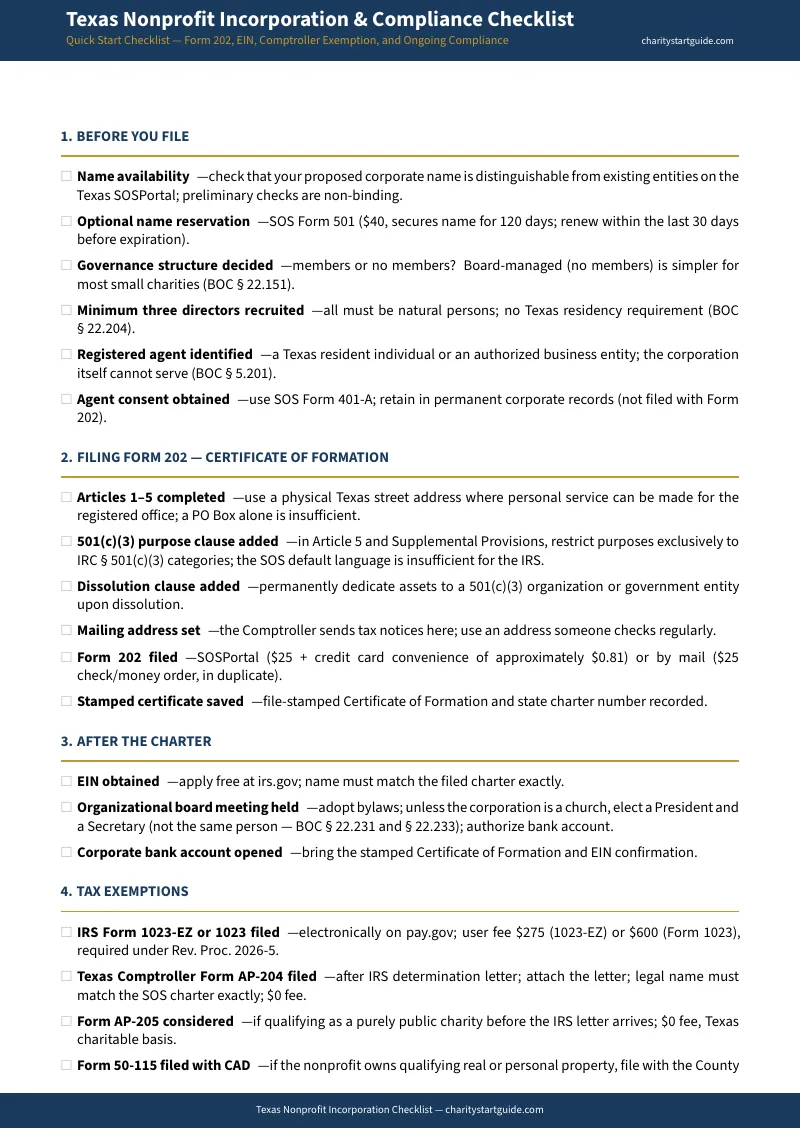
Download the free checklist to see the high-level filing steps. When your board is ready for the clause language, the SOSPortal walk-through, the Comptroller application sequence, and the Annual Compliance Calendar, the full guide is here.
Frequently Asked Questions
What if the rules change after I buy?
We update the guide when the rules change. Email us any time, even years later, and we'll send you the current edition free.